The £400 Jacket. The 24p Jacket.
Sometimes the best marketing idea is the one you didn’t have.
In October 2024, Berghaus launched its latest Icons campaign featuring a very recognisable face: Liam Gallagher.
Gallagher modelled the brand’s Trango jacket, a £400 outdoor jacket designed to celebrate the return of one of Britain’s most iconic musicians and Berghaus’ own heritage.
The campaign made sense.
Berghaus. Liam Gallagher. British heritage. The return of an icon.
But then the internet noticed something else.
The jacket was red, yellow and blue.
Very red. Very yellow. Very blue.
Lidl colours.
And once someone had pointed it out, noone could unsee it.
Comments started appearing comparing Gallagher's £400 Berghaus jacket to the colours of the German supermarket. Some joked that he looked like a Lidl employee. Others simply called it the “Lidl jacket”.
The joke started to spread.
And this is where Lidl did something smart.
They were listening.
Rather than ignoring the conversation because it technically had nothing to do with them, Lidl's social team joined in with a simple response to Liam Gallagher:
“Sound colour choices, @LiamGallagher.”
It was barely an advert.
But it was enough.
The brand had entered a conversation that consumers had already started for them.
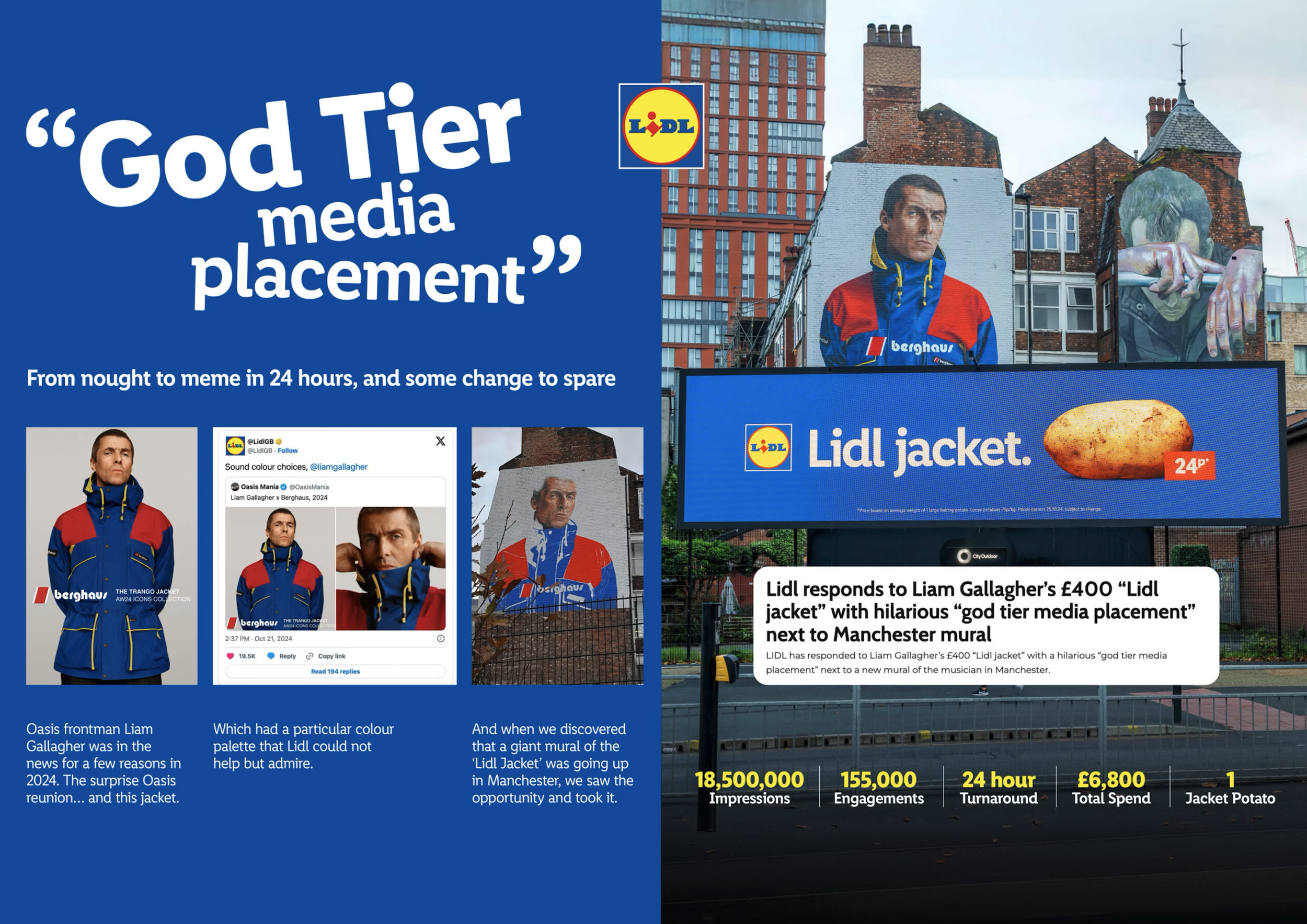
Image Source: Droga5
Then Lidl spotted the bigger opportunity
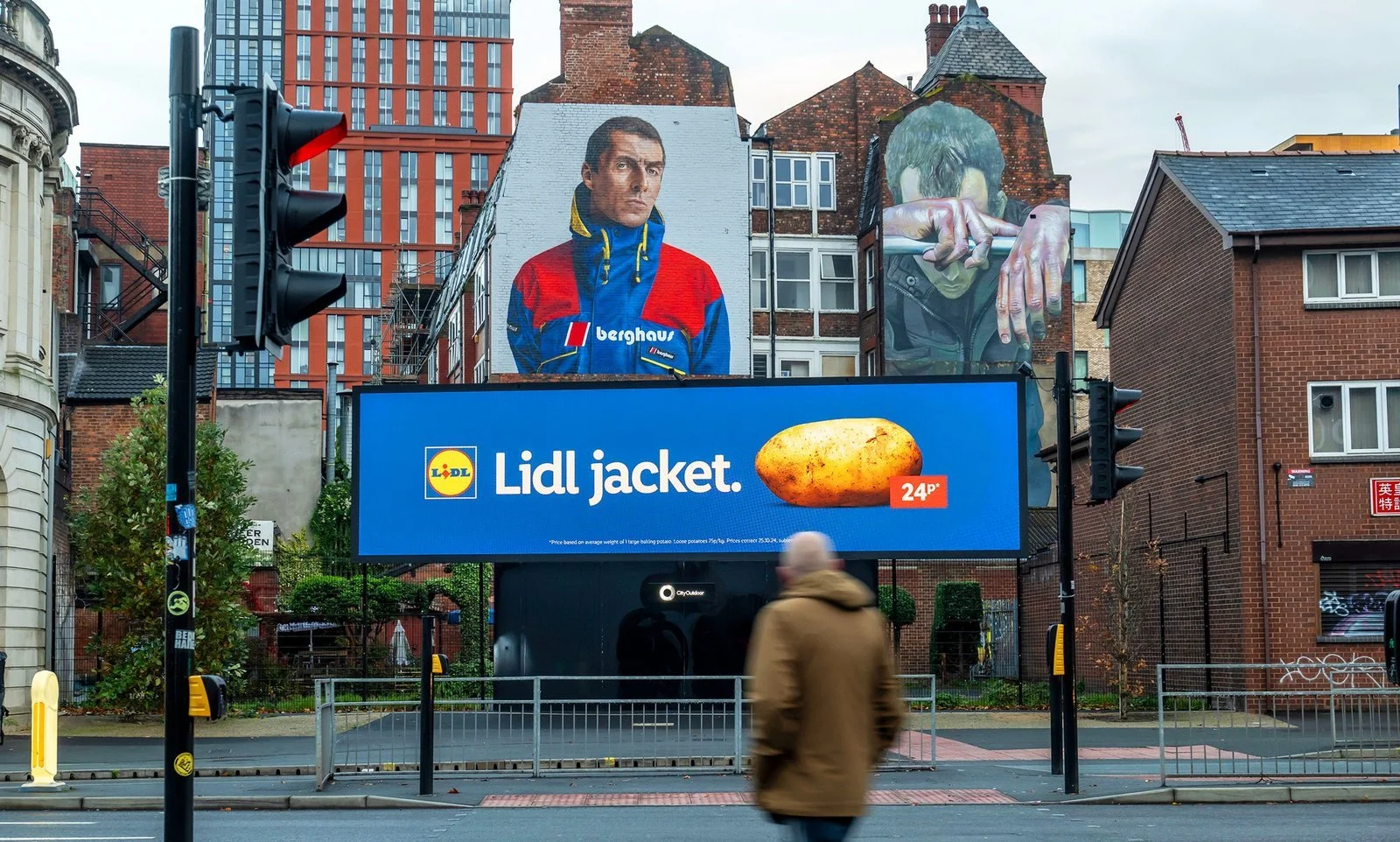
Berghaus had created a mural of Liam Gallagher wearing the jacket in Manchester as part of the campaign.
And Lidl saw the opportunity.
Instead of trying to recreate the joke online, they took it into the real world.
Directly underneath the huge Berghaus mural, Lidl placed an outdoor advert featuring a jacket potato.
The copy?
“Lidl Jacket.”
The Berghaus jacket cost around £400.
The Lidl “jacket” was a potato.
At the time, the potato was advertised at just 24p.
It was an absurdly simple idea.
And that's exactly why it worked.
The advert didn't explain the joke.
It didn't need a tagline explaining the strategy.
It didn't even really need Liam Gallagher.
The context did all the work.
You looked up and saw Liam Gallagher in the Berghaus jacket.
Then immediately underneath him:
Lidl Jacket.
A jacket potato.
24p.
The internet had made the connection.
Lidl simply finished the sentence.
This is what makes the campaign so good
Lidl didn't hijack the Berghaus campaign by pretending it was theirs.
They hijacked the conversation around it.
That's an important distinction.
The original Berghaus campaign had already paid for the celebrity, the photography, the media, the murals and the attention.
Lidl didn't need to create any of that.
They simply needed to recognise that something culturally relevant was happening — and respond before the moment disappeared.
According to campaign case studies, the Lidl team spotted the opportunity on the Wednesday, developed and pitched the idea, secured approval and had the outdoor execution live by Saturday.
Three working days.
That's the bit that is easy to overlook.
The idea itself isn't complicated.
The difficult part is having an organisation, client and agency relationship capable of moving quickly enough to make the idea relevant.
Because a reactive idea isn't really reactive if it arrives three weeks later.
Lidl turned someone else's £400 jacket into their own brand moment
There's another clever layer to this.
Berghaus wanted you to think about its £400 jacket.
Lidl made you think about its 24p jacket potato.
The comparison wasn't really between two jackets.
It was between two brands, two price points and two completely different worlds.
And Lidl's positioning made the joke particularly natural.
Lidl is a value supermarket.
So instead of being defensive about the association with a supermarket, they leaned into it.
They essentially said:
Yes. You think it looks like Lidl? Fine.
We'll make the joke better.
That's a powerful brand characteristic.
Confidence.
And the audience did half the marketing
The beauty of reactive marketing is that the audience becomes part of the creative team.
Someone makes the observation.
Other people repeat it.
The joke gains momentum.
The brand notices.
The brand responds.
Then the response becomes another piece of content for people to share.
The cycle feeds itself.
The Lidl billboard was subsequently shared across social media and picked up by the press, with people praising the placement as a “god tier” media buy.
And suddenly Lidl wasn't simply reacting to a Berghaus campaign.
Lidl had become part of the story of the Berghaus campaign.
That's a very different thing.
The really interesting part came later
Lidl didn't stop there.
When the Oasis reunion tour arrived in 2025, Lidl returned to the joke with an actual product.
They created the “Lidl by Lidl” jacket — a limited-edition £30 jacket inspired by Oasis and the original viral moment.
It came with drink-cooling pockets, a bottle-opener zip and even a tambourine. Lidl explicitly described it as a response to the social media demand for the “Lidl jacket”.
The joke had gone from:
“That looks like Lidl.”
to:
“Lidl should make that jacket.”
to:
Lidl actually makes the jacket.
That's a fantastic example of how a brand can turn an accidental association into something much bigger.
What started as a comment section joke became a social response.
The social response became an OOH campaign.
And the OOH campaign eventually became a real product.
That's not just reactive marketing.
That's building on momentum.
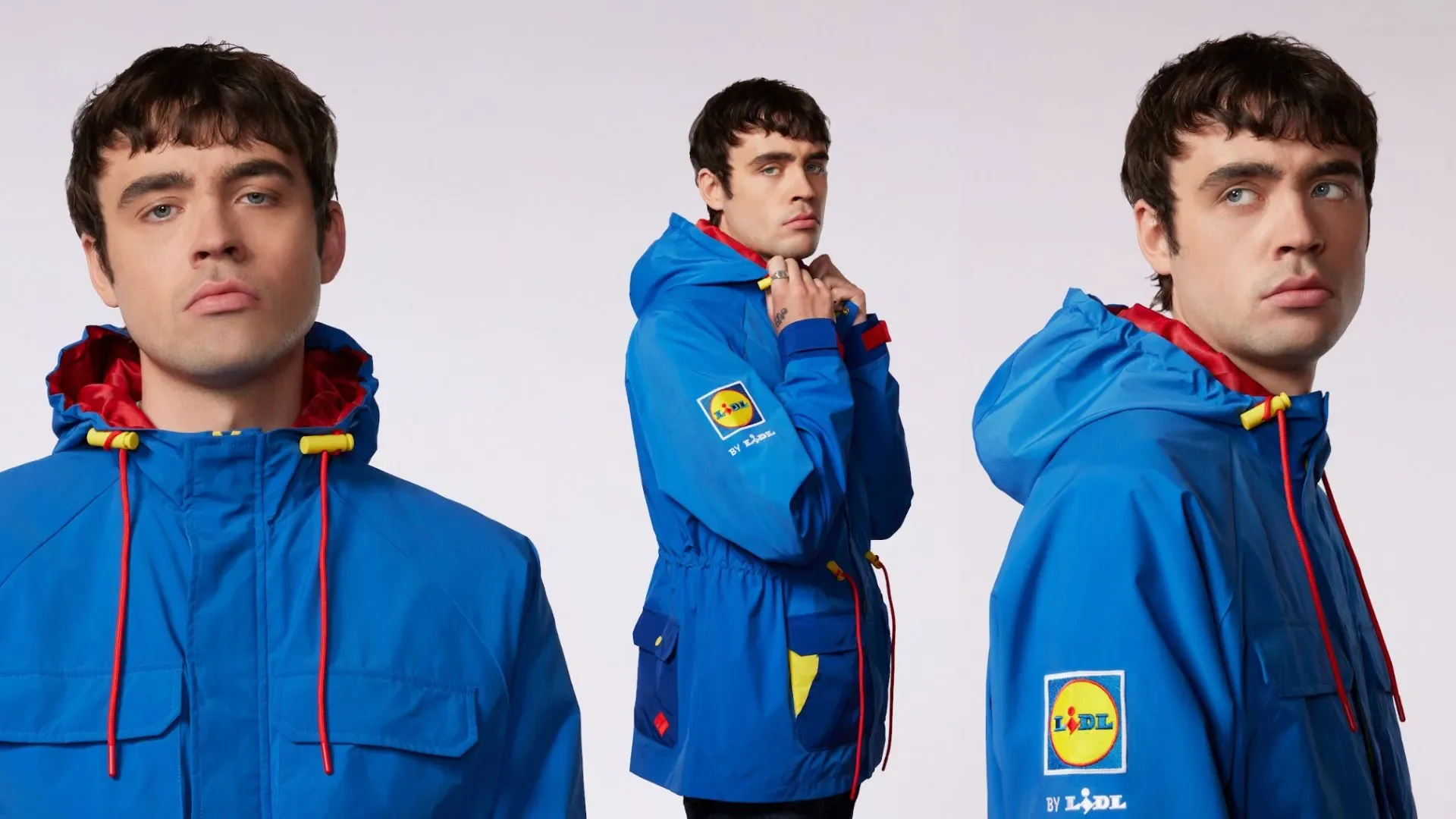
Image Credit: Lidl
The lesson for brands
There is a tendency to think that successful branding is about having the perfect campaign idea locked down months in advance.
Sometimes it is.
But brands also need to be capable of recognising when culture has handed them an idea for free.
Lidl didn't control the original conversation.
They didn't commission the Liam Gallagher campaign.
They didn't design the Berghaus jacket.
They didn't create the meme.
They didn't even start the joke.
They simply had the awareness to spot an unexpected association between their brand and something happening in popular culture.
Then they had the confidence — and importantly, the speed — to act on it.
That's the opportunity.
Because the best reactive marketing doesn't feel like a brand desperately trying to be relevant.
It feels like the brand was already part of the conversation.
And perhaps that's the biggest lesson from the Lidl jacket.
You don't always need to create the moment.
Sometimes you just need to be paying enough attention to recognise one when it arrives.
